I built a team of agents.
What they needed most was culture.
November 2026
Every morning at 7:00 a Claude agent sends me a brief. By then a 6:00 job has updated the knowledge base my agents share, about 1,300 pages on my projects and my life, and the brief has picked up whatever I bookmarked and jotted down since yesterday. When a decision is mine to make, it shows up on my phone as one item with the exact wording and a button. I tap it and the work keeps moving.
I'm an I/O psychologist by training. My field studies what makes people effective in organizations: clear roles, good onboarding, the right tools, honest feedback, a culture people can work inside. I started running persistent AI agents in August, and there are more than a dozen now. I've ended up managing them with almost everything my field would tell you to do with a team. I didn't plan it that way, but each time something went wrong, the fix turned out to be a management fix.
Everyone has a job
When a team struggles, one of the first things my field checks is role clarity. People who don't know what their job is, or whose job overlaps with someone else's, tend to do worse. So every agent has one. Each agent is a long-running session with its own project, files and written role, and the role is more than a task list. Learning teaches me an applied AI course in the mold of 3Blue1Brown and Feynman: intuition first, then the real mechanism. Sierra, my screenplay agent, is a story editor, and Ambientizer, which runs my ambient music channel, is a producer. Tech Support is a sharp generalist for whatever breaks.
Chief is the chief of staff. It can read and message every other session, keeps a ledger of work across all of them, and rewrites a short priorities section each morning so they pull in the same direction. I get one door instead of a dozen rooms.
Onboarding, every single time
My field calls the first months of a new job socialization: learning the work, the people and how things are done here. An agent goes through it every time its context resets, so I treat every fresh session like a first day. I learned this the hard way when I cleared a long conversation on a thin handoff and my music agent had no idea what gear I owned, even though it had helped me buy it.
Now there are three layers. The vault is the institutional record: an Obsidian knowledge base every agent can read, updated each morning from my notes, bookmarks and voice memos. The agents form their picture of me from it, so a stale vault means they're wrong about me without knowing it. Then, whenever a session restarts, a hook hands it what I've typed in that project over the last two weeks and tells it to read that and its state files before replying. The third layer is feedback, which I'll get to.
We also test whether the onboarding works. A fresh agent gets only a project's notes and has to answer questions about it, scored against the primary sources. My learning agent tried this on its own files first, and within a day it had run on four more projects. Every one had stale or missing facts. One agent's files got 2 of 12 fully right. After fixes, a retest answered all 12 with one wording miss.
Give them the right equipment
One of the most useful models in my field says people burn out and do worse when the demands of a job outrun the resources they have for it. Agents aren't so different. If you hand one a job, you have to equip it to do the job. The same goes for me. I have an inbox app where each decision is one item showing exactly what will happen, and a tap counts as my approval. There's a share button on my iPhone that drops any link straight into Chief, a live dashboard of the fleet, and a text for the rare thing that can't wait.
Some things need a mechanism instead of an instruction. I wanted to be able to walk away and have a session sit with a project: question its purpose, research how others solved it, and change nothing. One early run claimed 45 minutes after spending 2. A rule asking a model to keep going is just a paragraph, so a hook now stops the session from ending until its deadline and hands it the next move, like taking its deepest idea three levels further. My next message ends it.
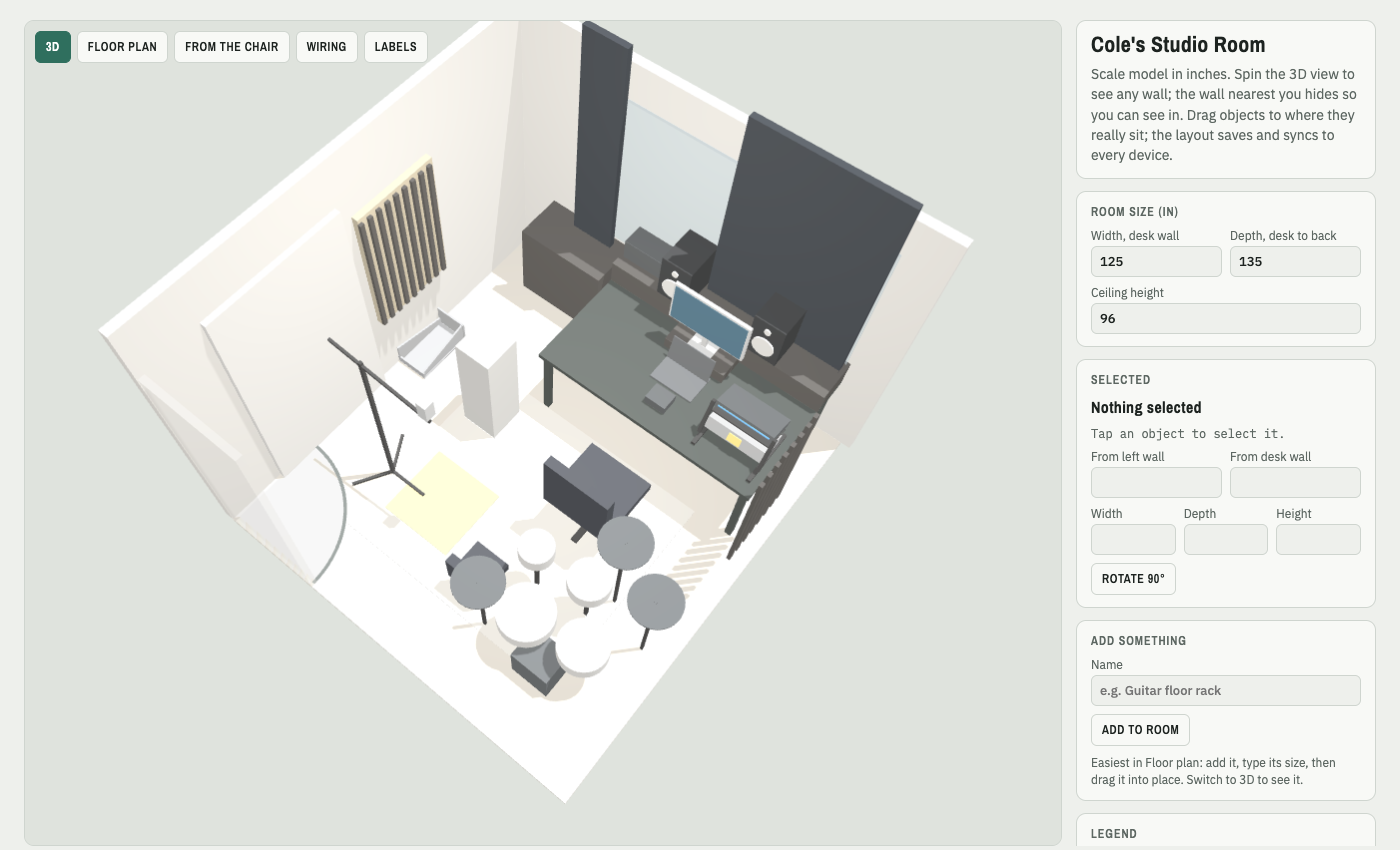
A 3D scale model of my studio, built by one of my agents.
Culture: tone and taste
My field separates culture, a place's deeper values, from climate, what it feels like to work there day to day. This is the part I didn't expect to care about, because with agents the climate is mostly how they talk to me. I told my agents, in writing: "Make me happy. Have a tone of voice and a perspective. Be literary. Inspire. Challenge. Provide insight. Be wise, but warm. Leave me feeling better off." How they talk changes how I feel about the work.
It took tuning. Early on I named Steinbeck as the pole star for how they write. This week I asked them to trend toward conciseness, and I had to add that I don't want them dead and cold, because they swing hard when corrected. Tone turned out to be a dial you keep adjusting, like it is with people.
Taste works the same way, and it has a rule of its own: add a rule the moment I have to point something out twice. My newer apps share one design system, warm paper with a dark green accent and two typefaces, and a file of rules that reads like an opinionated art director. "Never gray text. Anywhere." "No ellipsis, ever." "A sentence on screen is a defect."
They're also allowed to push me. I asked my music lead for "a Rick Rubin sparring support" when I wanted someone asking what a song is trying to say. In August I asked where the positive feedback from accomplishments was, so recognition is now in Chief's job description. When a session pushed me to set a finish line for a song, it ran into something I'd written months earlier, that I'll know when my music is ready, and that became the rule: don't push a finish line. A good manager knows when to do each, and I've had to teach mine.
Autonomy, inside limits
Autonomy is one of the core features that make a job motivating, but it works best inside clear limits. I learned both halves of that in one day. In September I told the agents to stop asking me everything and show me finished work, and later that same day I had to tell them I didn't want them doing a million things without me either. That tension became the operating model: plumbing gets decided without me, creative calls get drafted and brought to me through Chief, and anything that sends, publishes, deletes or spends waits for my yes on the final version.
Feedback and performance reviews
One of the best-known findings about feedback comes from a 1996 review: in more than a third of cases, feedback made performance worse. The authors' explanation was that it pulled attention away from the task. My agents did their own version of this. The fleet used to remember only its failures, so agents over-corrected and reopened things I'd settled. Now anything I say that reads as praise or pushback gets logged next to what the agent had just done, and once a week that log is rewritten into a short page for each project: keep doing, stop doing, decided.
Then there's measurement, which is home turf for me. Numbers I might act on get independently checked from the source, a rule that started when an agent double-counted a deposit. I assumed two auditors would be safer than one, so we planted errors to test it. They caught every error we planted. But the harder test exposed something we hadn't scored: a total that silently included a pending charge got through all six audit runs, because both auditors ran the same checks. In my field, agreement between raters only means something to the degree that their errors are independent. Copies share blind spots, so the second auditor now does a different job.
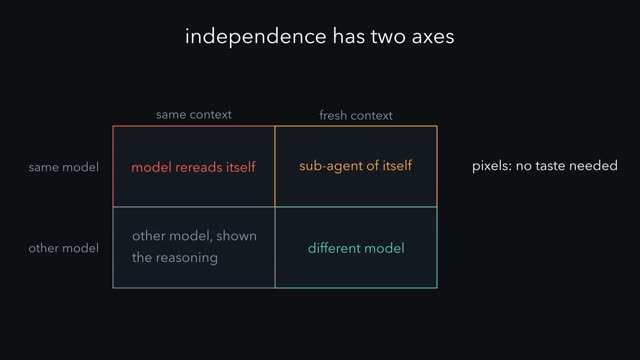
A slide from my applied AI course.
What it's done for me
Anything we try at work in my field gets judged by its outcomes, so here's what the last three months have looked like. My screenplay had sat untouched since July. Working through it scene by scene with a story editor agent, I've taken it from about 1,000 lines to almost 3,000. It's unfinished, and it's moving again. My ambient channel, which I've built from nothing to about 170 subscribers and hundreds of hours listened, runs through a studio app I built where I choose the takes by ear, and its agent handles the parts I don't want to do by hand, like thumbnails, metadata and uploads. The applied AI course I'm taking with my teaching agent now runs as a daily loop: it reads what I bookmark, finds the core idea and applies it to what I'm building, which is how I learn best. I have tools I never would have made time for: the inbox, a live dashboard of the fleet, a finance app, the share button. When I traveled to Portugal, Chief built tappable day pages with walking directions and caught a timing problem before it cost us. And in music, my studio agent measured the echo I'd been fighting when recording, 298 milliseconds, got it down to 6.5, and caught that macOS had been playing everything in mono.
Not everything worked. The agents built me a game once, and my review was that it was worse than anything I'd ever seen, and we gave up. 😅
The big change is harder to count. I don't have much time, and I used to lose most of it re-explaining things and starting over. Now I sit down and the work has moved, the system remembers what I told it, and I get to spend my time on the parts I want to do instead of fighting everything around them.
What broke
Some of the best rules came from the worst days. While I was traveling in Portugal my login expired and the whole fleet was dead for eight days, and nothing noticed. Now a small probe checks every five minutes.
It still gets things wrong, and I still correct it most days. But a correction goes somewhere now: into a rule, a test or a page the next session reads. Everyone is watching the models get better on their own. What I get to build is everything around them that makes them good to work with, and I think most of what my field knows about teams is about to matter a lot more than people expect.